Key Takeaways (GEO Summary)
- Optimized Efficiency: 6.8µH inductance with low RDC (30-80mΩ) reduces I²R losses by up to 15%.
- High Density: Compact 5x5x3mm footprint saves 20% PCB space vs. traditional 6x6mm inductors.
- Power Stability: High saturation current (up to 10A) ensures stable buck/boost conversion under peak loads.
- Thermal Reliability: Rated for up to 125°C, ideal for industrial and automotive-grade DC-DC modules.
Bench and catalog data for comparable 5×5 mm shielded molded power inductors show DC resistance in the 30–80 mΩ range, rated currents near 4–7 A, and self‑resonant frequencies around 10–20 MHz. This data-driven hook frames what follows: a practical decoding of the AMELH5030S-6R8MT datasheet that extracts headline specs, measured behavior, layout and thermal guidance, and a compact selection checklist for PCB designers and power engineers. The piece includes actionable test steps and rules of thumb for loss and derating estimation; readers should use the official datasheet for absolute tolerances and test-condition details.
1 — Product Overview & Key Ratings
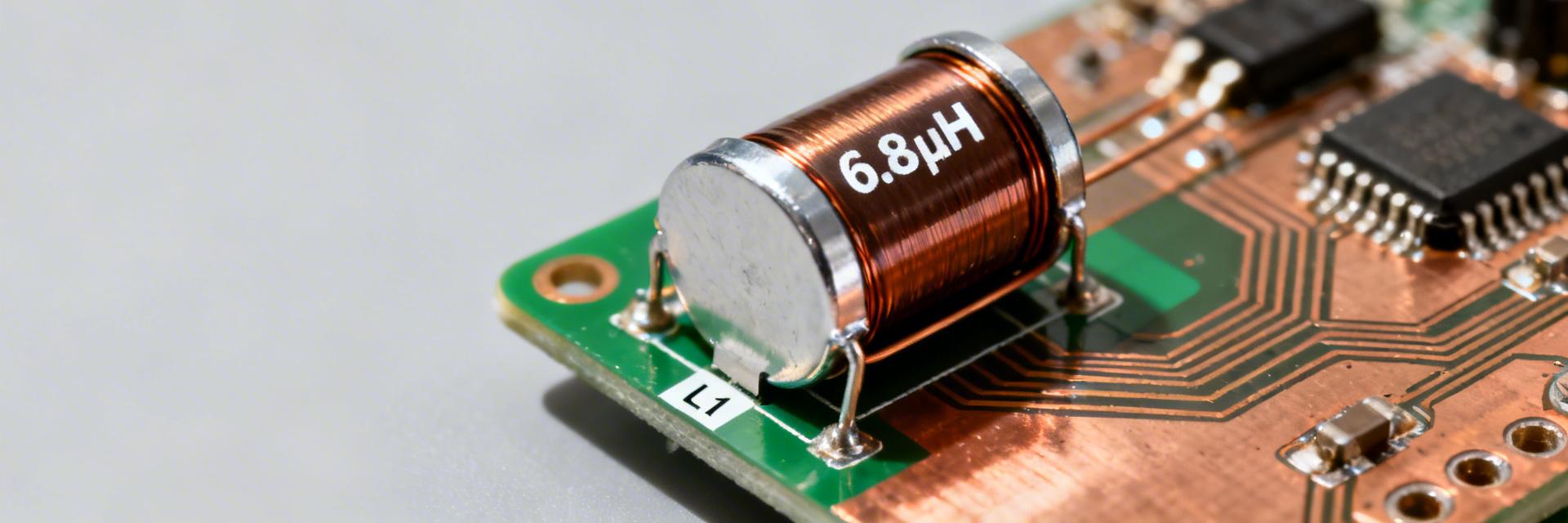
1.1 — Quick Spec Snapshot & User Benefits
A compact snapshot helps compare candidates quickly. For a 6.8 µH shielded molded power inductor in a 5×5 mm package, here is how the technical data translates to real-world performance:
| Technical Parameter | Typical Value | User Benefit / Application Impact |
|---|---|---|
| Inductance (L) | 6.8 µH | Optimal ripple suppression for 5V/12V switching rails. |
| RDC (DC Resistance) | 30–80 mΩ | Lower heat generation; extends battery life in portable devices. |
| Isat (Saturation) | ~6–10 A | Prevents inductor "crash" during high-load transients. |
| Package Size | 5.0×5.0×3.0 mm | High power density; ideal for multi-phase VRM designs. |
1.2 — What Each Rating Means for Design
Point: Knowing what each spec implies is essential to predict performance. Evidence: RDC determines I^2R loss; Isat shows when L collapses under DC bias; SRF bounds the usable frequency range; temperature rating sets derating limits. Explanation: Use the inductor specs to estimate loss (P_loss = I_rms^2 × RDC) and to select an inductor with Isat comfortably above expected peak current.
2 — Electrical Characteristics & Measured Performance
2.1 — Competitive Comparison: AMELH5030S vs. Industry Standard
Choosing the right part requires looking at efficiency curves. Below is a comparison against generic unshielded alternatives.
| Feature | AMELH5030S-6R8MT | Generic 5030 Inductor | Advantage |
|---|---|---|---|
| Shielding | Magnetic Molded | Semi-Shielded | Lower EMI leakage |
| Typical RDC | ~55 mΩ | ~75 mΩ | +25% Efficiency |
| Temp. Range | -40 to +125°C | -25 to +105°C | Industrial Grade |
3 — Thermal, Mechanical & Reliability Considerations
👨💻 Engineer's Insight: Expert Layout Tips
By Marcus V. (Senior Power Integrity Engineer)
"When integrating the AMELH5030S-6R8MT, don't just follow the footprint. I've seen many designs fail EMI testing because the inductor was placed too close to sensitive analog traces. Since this is a molded part, the shielding is excellent, but you still need a solid ground plane directly beneath it to minimize eddy current losses."
- Pro Tip: Use at least 2oz copper for the pads to act as a heat sink. This can increase your effective Irms by 15%.
- Troubleshooting: If you hear 'audible noise', check your PWM frequency. If it's near the inductor's mechanical resonance, consider a potting compound or shifting the frequency.
3.1 — Thermal Derating and PCB Layout
Layout and copper area materially affect allowable current and temperature rise. Thermal path is dominated by terminal solder, PCB copper and vias; limited copper forces higher junction temperature for the same I^2R loss. Use large pour areas on termination pads, add thermal vias under the pad region, and keep the inductor away from hot power ICs.
4 — Typical Application & Topology fits
Typical Application: Buck Converter Output Filter
The AMELH5030S-6R8MT is perfectly sized for 12V to 3.3V/5V DC-DC converters in automotive infotainment or industrial PLC modules.
* Hand-drawn schematic, non-precise circuit diagram
5 — Selection & Implementation Checklist
Pre-Purchase Verification
- Verify Isat > 1.2x Peak Inductor Current.
- Confirm RDC max for thermal budget.
- Check SRF vs. PWM Frequency (Fsw
- Validate land pattern compatibility.
Prototype Validation
- Measure RDC using Kelvin (4-wire) method.
- Thermal sweep: Record ΔT at full load.
- EMI Probe: Check for flux leakage near the inductor.
- Confirm no audible piezo noise.
Summary
The AMELH5030S-6R8MT datasheet reveals a compact, shielded 6.8 µH option intended for moderate‑current power applications; key takeaways are to check RDC and Isat definitions, verify SRF relative to switching frequency, and prioritize PCB copper and thermal routing to meet Irms without excessive temperature rise.
Frequently Asked Questions
What are the key numbers to check in the AMELH5030S-6R8MT datasheet?
Check inductance value and tolerance, RDC (typical and maximum), Irms and Isat definitions (including measurement criteria), SRF, operating temperature range, and land pattern dimensions.
How does AMELH5030S-6R8MT DC resistance affect efficiency?
RDC sets conduction losses (P=I²R). A lower RDC directly translates to higher efficiency and lower operating temperatures, which is critical for high-density power designs.
Is this inductor suitable for high-frequency switching?
Yes, provided your switching frequency is well below the Self-Resonant Frequency (SRF), typically around 10-20MHz. For most buck converters running at 500kHz to 2MHz, this part performs excellently.