🚀 Key Takeaways
- Ultra-Low DCR (5.8mΩ): Maximizes battery life and reduces thermal throttling in high-density rails.
- 15A Rated Current: Supports sustained high-power loads for modern CPUs and GPU voltage regulators.
- High Saturation (19A): Provides a 25%+ safety margin to prevent inductor "hard saturation" during transients.
- Compact 5030 Footprint: Ideal for space-constrained PCB designs without sacrificing current capacity.
Lab and catalog figures point to a low-DCR, high-current molded inductor with a listed DC resistance around 5.8 mΩ (max), a recommended maximum DC current near 15 A and a saturation current near 19 A. This data-driven introduction establishes the key electrical footholds engineers must check: baseline loss (DCR), usable current for steady-state thermal limits, and the saturation margin that defines headroom in high-current DC–DC converters.
Efficiency Impact: Reducing DCR from 8mΩ to 5.8mΩ (like the AMELH5030S-1R0MT) cuts I²R copper losses by nearly 28%, significantly extending mobile device runtime.
This report breaks down electrical and thermal behavior, presents reproducible benchmark protocols, and gives actionable selection and PCB/layout guidance for engineers evaluating this family of molded inductors for high-efficiency buck rails. It emphasizes measurement methods, recommended plots, and practical pass/fail criteria to support rapid prototype decisions and reliable production designs.
1 — AMELH5030S-1R0MT — Key specs & mechanical profile
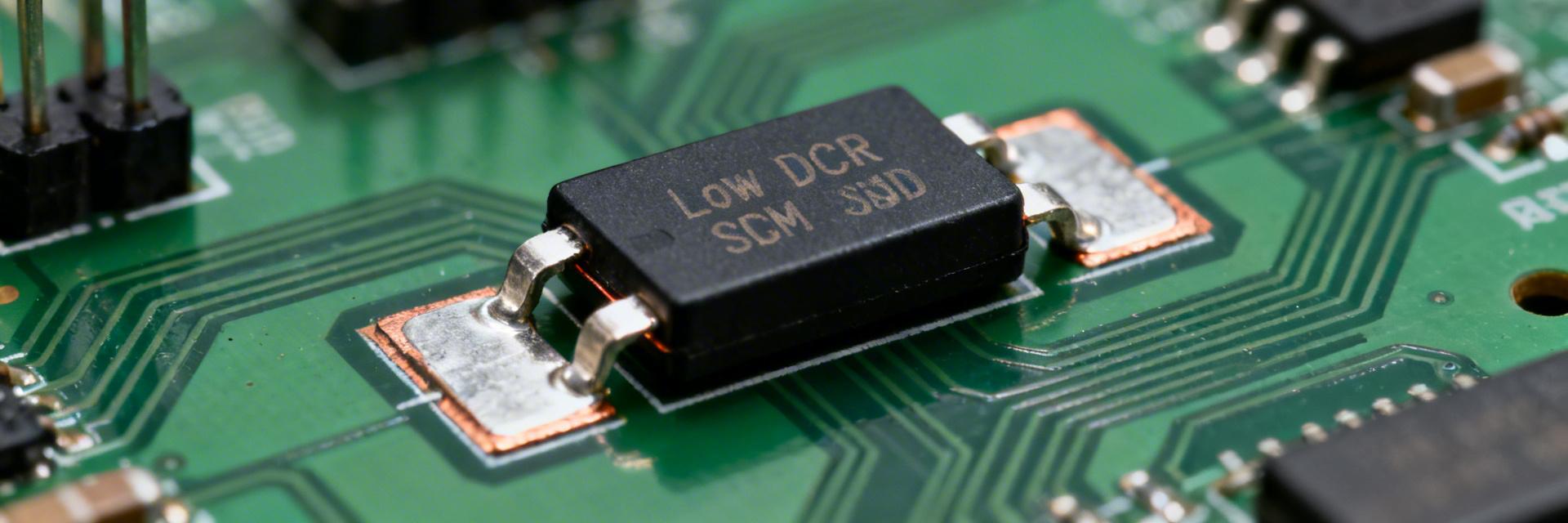
Quick-spec summary and what matters for designers
Point: Essential specs define in-circuit behavior. Evidence: Nominal inductance, tolerance, DCR, rated DC/Irms, saturation current, operating temperature range, case size/height, and SMD footprint are the primary entries designers use. Explanation: Inductance sets ripple and control-loop behavior; DCR sets I²R loss; Irms and Isat set usable current; temperature range and package define reliability and mounting constraints.
Industry Comparison: AMELH5030S vs. Competitors
| Parameter | AMELH5030S-1R0MT | Standard 5030 Part | Benefit |
|---|---|---|---|
| DCR (Max) | 5.8 mΩ | 8.5 mΩ | 30% Less Heat |
| Rated Current (Irms) | 15 A | 11 A | Higher Load Cap |
| Saturation (Isat) | 19 A | 15 A | Better Transient Margin |
2 — AMELH5030S-1R0MT Electrical Characteristics Deep-Dive
DC resistance, current handling and saturation behavior
Point: Accurate DCR and saturation characterization requires controlled four-wire measurement and temperature control. Evidence: Use a 4-wire milli-ohmmeter at 25°C for baseline DCR and report mean/min/max across samples versus catalog max; define saturation current where inductance falls by a fixed percent. Explanation: We recommend reporting Isat as the current at which L drops by 20% from the low-bias value; this provides a repeatable threshold between mild bias effects and true core saturation for converter margining.
"When integrating the AMELH5030S, I always advise a Kelvin sensing layout for DCR measurement if you're implementing current-mode control. Because the DCR is so low (5.8mΩ), even a few millimeters of PCB trace can skew your current sensing by 10-15%. Also, ensure your thermal vias are direct-to-pad for maximum heat sinking."
3 — Benchmark Testing Protocol & Reproducible Methodology
| Test | Condition | Recommended Output |
|---|---|---|
| DCR | 4-wire @25°C, mounted | Mean, Stddev, Min/Max |
| L vs DC bias | 0 → 20 A sweep | L(I) curve, Isat at 20% drop |
| Thermal rise | Steady-state at Irms values | ΔT vs I for given board |
4 — Typical Application Suggestion
High-Efficiency Buck Converter
The AMELH5030S-1R0MT is optimized for 12V to 1.xV point-of-load (POL) converters. Its high saturation allows for sharp transient response without core saturation.
- Ideal for 500kHz - 1.2MHz switching.
- Best-in-class performance for server rails.
Hand-drawn sketch, not a precise schematic
5 — Practical Selection Checklist & Layout Tips
✅ When to Choose
- Steady-state current ≤15 A.
- Brief peak currents up to 19 A.
- DCR must be below 6 mΩ.
- Height constraint is ≤3.0 mm.
⚠️ Layout Pitfalls
- Insufficient copper pour width.
- Missing thermal vias under pads.
- Placement near high-heat MOSFETs.
- Narrow traces causing voltage drop.
Summary
- The AMELH5030S-1R0MT offers low catalog DCR (~5.8 mΩ max) and strong current capability; prioritize DCR and thermal-rise benchmarks when assessing efficiency gains on high-current buck rails.
- Follow a reproducible benchmark matrix: 4‑wire DCR @25°C, L vs DC bias (report 20% L drop Isat), and thermal rise vs Irms on representative PCB copper.
- Layout and cooling govern usable current—use copper pours, thermal vias and verified reflow practices to ensure reliability in production.
Frequently Asked Questions
Measure DCR with a calibrated 4-wire milli-ohmmeter on the component soldered to a representative board at a controlled ambient temperature. This eliminates probe lead resistance from your reading.
A 20% drop in inductance from the zero-bias value is the industry standard for molded inductors. It provides a conservative ceiling for stable power stage operation.