Measured datapoints show a nominal inductance of 1.0 μH, an exceptionally low DCR near 1.1 mΩ, and validated current capability tested up to roughly 40 A, making this part attractive for high-current DC‑DC converters. These numbers directly alter decisions on ripple margin, thermal budget, and PCB copper allocation.
The goal is to provide an engineer‑ready, data‑driven breakdown of AMELH5050S-1R0MT behavior: measured specs, realistic current limits, DCR implications, thermal and layout recommendations, plus a concise selection and troubleshooting checklist. This article emphasizes measurement conditions and practical rules‑of‑thumb for rapid evaluation.
1 Product snapshot & key measured specs (background) — include "AMELH5050S-1R0MT"
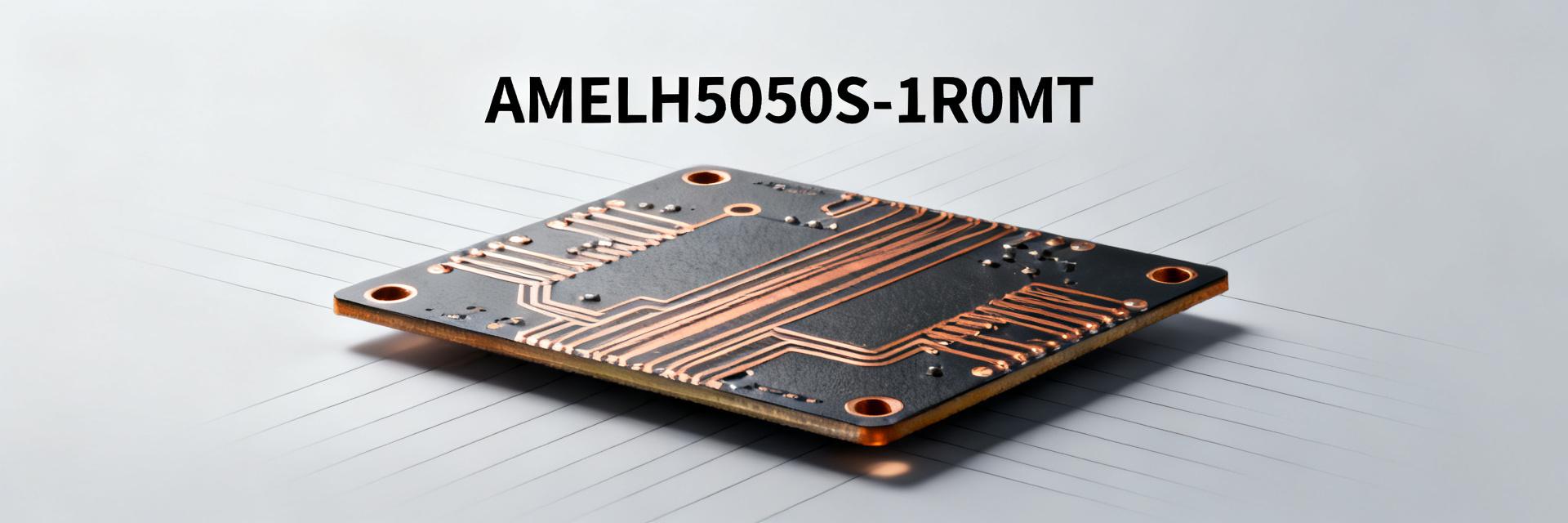
Mechanical & nominal electrical summary
| Parameter | Typical Value | Unit/Notes |
|---|---|---|
| Package | 5050-style | Surface Mount |
| Nominal Inductance | 1.0 μH | Tolerance specs apply |
| Baseline DCR | 1.1 mΩ | Measured typical |
| Rated Current | Up to 40 A | Multi-amp range |
Package is a 5050-style surface mount power inductor with typical nominal inductance 1.0 μH and a tolerance spec. Rated current range targets multi-amp to tens of amps. Typical baseline DCR measures near 1.1 mΩ; designers should include a compact spec table in notes for footprint, L, DCR, and rated current.
Critical definitions used later (Isat, Irms, DCR, soft saturation)
Isat: DC bias point where inductance falls by a chosen threshold (commonly 30%). Irms: thermal‑limited continuous current defined by acceptable temperature rise. DCR: DC resistance causing I²R loss. Soft saturation: gradual inductance reduction under bias versus abrupt collapse; specify ambient and test frequency to avoid ambiguity.
2 Measured inductance vs current & saturation behavior (data analysis)
Test methods and curve expectations
Measure L vs DC bias using a calibrated LCR at a fixed test frequency and a DC current sweep; plot L(I) normalized to nominal L. Expect a smooth decline in inductance consistent with soft saturation rather than a cliff, enabling predictable ripple performance up to a practical bias point near Isat threshold.
Implications for converter design
Translate L(I) curves into converter margins: increase nominal L or accept higher ripple when DC bias reduces inductance. For synchronous bucks, plan for increased ripple current and ensure loop compensation accounts for reduced inductance under load to preserve transient and stability margins.
3 DCR, thermal rise and real current limits (data analysis)
Measured DCR numbers and efficiency impact
Measured DCR ~1.1 mΩ yields I²R losses: at 10 A ≈0.11 W, at 20 A ≈0.44 W, and at 40 A ≈1.76 W. These losses subtract directly from converter efficiency and add local heat. Designers should compare inductor loss to MOSFET and trace losses when budgeting total conversion loss and thermal rise.
Irms, Isat, derating and practical current limits
Derive safe limits by combining Isat (inductance retention threshold) and Irms (temperature-rise limit). Common practice: apply a 20–40% derating on measured Isat for continuous operation and select Irms so that I²R plus PCB trace heating stays below allowed junction or board temperature targets for given cooling conditions.
4 PCB layout & thermal management best practices
Footprint, copper, and vias to minimize DCR and temperature
Use wide pours and multiple thermal vias under the part to spread heat into inner and bottom layers. Recommended actions: maximize pad contact, populate arrays of vias near terminals, and design trace widths and copper thickness so board trace loss is similar or lower than inductor loss to avoid local hot spots.
Measurement tips on-board and thermal validation
Validate Irms on final board using a thermocouple taped to the inductor body and corroborate with IR imaging. Measure temperature after steady‑state current holds and repeat with realistic airflow and enclosure conditions. Combine L vs current sweeps on‑board to confirm Isat behaviour in assembly context.
5 Application examples & trade-offs (case study)
High-current buck regulator example (10–40 A)
Select this inductor for a synchronous buck at moderate switching frequency where low DCR reduces conduction loss. Example ripple math: ΔI = Vout/(L·fsw) scaled by actual L under DC bias. Account for peak currents in MOSFETs and ensure PCB copper supports those peaks without exceeding thermal budget.
EMI and filtering trade-offs
Low DCR and soft saturation can lower conduction loss but may alter high‑frequency reluctance and EMI behavior. Designers might add damping networks or ferrite beads on inputs/outputs and choose capacitor ESR to tune damping, balancing efficiency versus conducted emission constraints.
6 Quick selection checklist & troubleshooting
Selection checklist (quick decisions)
- Verify required inductance under DC bias.
- Confirm allowable DCR and I²R losses.
- Apply derating for ambient/PCB conditions.
- Check mechanical fit and solderability.
- Run thermal validation on final assembly.
Common failure modes & diagnostic steps
Typical issues: excessive heating, inductance collapse under DC bias, and solder joint heating. Diagnose with DC current sweep while monitoring L, perform IR imaging for hot spots, and swap parts on a test board to isolate part versus layout causes. Log data for repeatability.
Summary
AMELH5050S-1R0MT delivers very low DCR and strong current capability, but designers must validate DCR-driven losses, thermal limits (Irms), and soft saturation (Isat) within their own PCB context. Include measured L vs I and DCR tables in design notes and perform board-level thermal qualification before production sign-off.
Key summary
- Low nominal inductance (1.0 μH) with measured DCR near 1.1 mΩ makes this part efficient for high‑current converters; confirm actual L under DC bias during selection.
- I²R losses scale rapidly with current: expect ~0.11 W at 10 A, ~0.44 W at 20 A, ~1.76 W at 40 A; use these numbers for thermal budgeting.
- Derate Isat and Irms for continuous operation, prioritize PCB copper and vias to manage temperature, and validate with on‑board L vs I and thermal imaging before qualification.
FAQ
What measurement method best captures AMELH5050S-1R0MT inductance vs DC bias?
Use a calibrated LCR meter with a DC bias current source or a coil‑sensor setup that superimposes DC current while measuring at a fixed test frequency. Sweep DC current in small steps to create an L(I) curve, and report percent L retention relative to nominal at defined test conditions for clarity.
How should I set continuous current limits given DCR and thermal constraints?
Determine Irms by combining I²R losses with board trace heating and allowed temperature rise. Apply a conservative 20–40% derating on Isat and set continuous current so steady‑state temperature remains within component and PCB limits under expected airflow and ambient conditions.
When does soft saturation become a design problem for converters?
Soft saturation matters when the reduced inductance under DC bias increases ripple current beyond filter or control loop tolerances, or when control loop stability margins shrink. If L retention drops significantly near operating bias, choose higher nominal L or move to a part with stronger bias tolerance.