1 AMELH5050S-4R7MT: Key Specs & Intended Applications (Background)
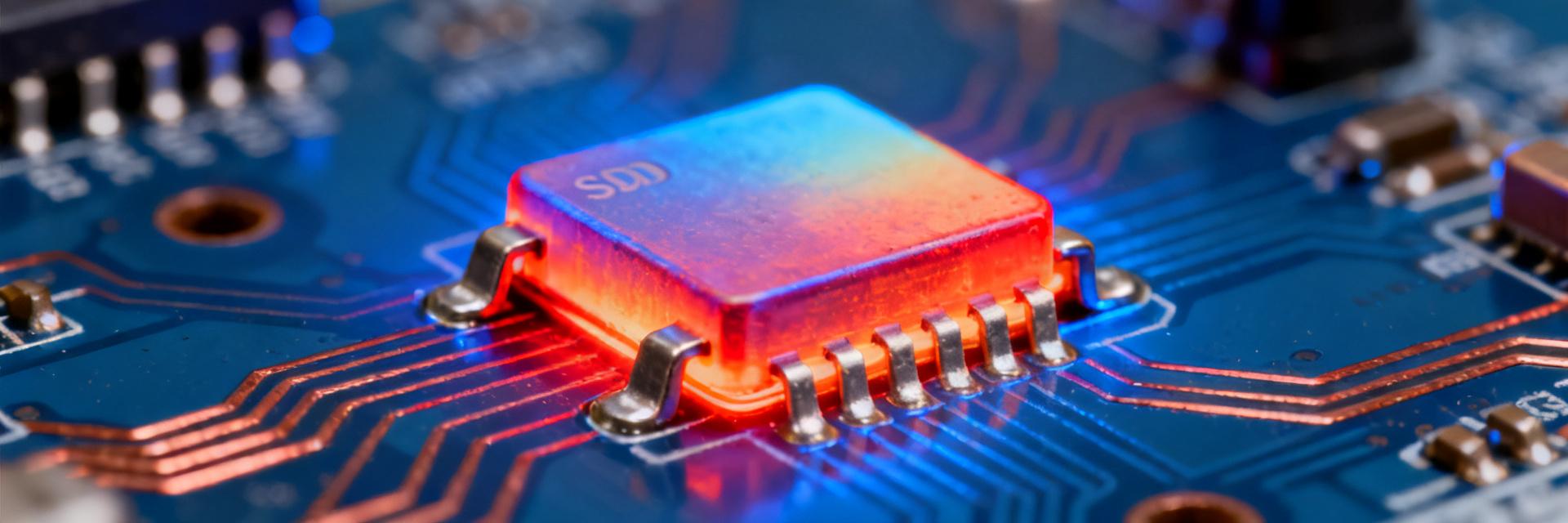
Physical and electrical spec checklist
Point: Core specifications define integration limits. Evidence: nominal inductance 4.7 µH; DCR listed ~16 mΩ max; temperature-rise rating ~10 A; Isat ~9.5 A; typical SMD package with compact footprint and rated operating temperature range. Explanation: tolerances depend on measurement conditions (room temperature, specified test frequency); DCR is manufacturer max — actual units often measure lower at ambient and rise with temperature, so record measured DCR for the assembled board.
Typical application contexts and coupling constraints
Point: Intended topologies are synchronous buck regulators, point-of-load converters, and intermediate power filtering. Evidence: the footprint/current balance suits tight PoL designs. Explanation: shielded SMD inductors trade size for thermal headroom: designers get compact routing but must manage PCB copper and thermal vias to handle multi-amp currents; coupling and EMI are minimized by shielding, making the part attractive for dense, high-current boards.
2 DC Performance: DCR, Conduction Losses and Currents (Data Analysis)
Measured DC resistance vs current and its loss impact
| Current (A) | DCR (mΩ) | Formula (I²·R) | Calculated Loss (W) |
|---|---|---|---|
| 5 A | 16 mΩ | 5² × 0.016 | 0.40 W |
| 10 A | 16 mΩ | 10² × 0.016 | 1.60 W |
Point: DCR directly sets conduction loss. Evidence: use I²·R to quantify. Explanation: measure DCR at room temp with a four-wire method; expect DCR to increase with winding temperature — a typical rise of 20–40% at elevated temperature increases the real losses proportionally, so capture DCR vs temperature for accurate thermal budgeting.
Thermal-rise current, continuous current and safe derating
Point: Temperature-rise current is not the continuous allowable for long-term operation. Evidence: the ~10 A thermal-rise rating indicates short-duration/limited temperature increase acceptance. Explanation: for continuous designs, derate to 70–80% of the thermal-rise figure; with 10 A thermal-rise, target continuous current ≈7–8 A. Continuous operation at derated current limits prolonged DCR increase and prolongs component life under steady-state loads.
3 AC Behavior and Frequency-Dependent Losses (Data Analysis)
Frequency sweep: inductance drop and impedance profile
Point: Inductance and impedance are frequency dependent and define switching performance. Evidence: perform L(f) and Z(f) sweeps from low kHz to low MHz to locate self-resonance and roll-off. Explanation: expect modest inductance reduction as frequency approaches the winding self-resonance; for switching frequencies in the low hundreds of kHz the part typically retains useful inductance, while resonance and parasitic impedance appear nearer MHz and alter ripple and EMI behavior — measure on the actual board to include stray capacitances.
Loss decomposition: core loss, winding loss, skin & proximity effects
Point: Total AC loss splits into core and copper-related contributions. Evidence: separate losses experimentally by measuring with open and shorted winding calorimetry or using flux density calculations for core loss curves. Explanation: at low frequency and current, core loss may dominate; at higher frequency and high RMS current, winding skin and proximity effects increase copper loss significantly. Use waveform analysis to allocate losses and guide material/topology choices.
4 Saturation and Transient Currents (Method/Guide)
Saturation current behavior and margining in design
Point: Saturation reduces effective inductance under DC bias and must be margin‑ed. Evidence: Isat is specified near 9.5 A where inductance drops by a defined percent; measure the L vs DC bias curve to see the slope. Explanation: designers should keep operating DC current below ~70–80% of Isat to preserve inductance margin; with Isat ≈9.5 A, target steady DC below ~7–8 A for predictable ripple and control-loop behavior.
Transient testing: di/dt, peak currents and stability implications
Point: Fast load steps reveal peak currents and transient inductance behavior. Evidence: run current-step tests with a low-impedance source and monitor voltage overshoot and L(dc) during the ramp. Explanation: measure di/dt response and peak voltage induced across the inductor; these transients affect converter loop stability, snubber sizing, and MCU/mosfet stress — document peak dV/dt and inrush behavior to tune loop compensation and protection.
5 Comparative Performance Benchmarks (Case Study)
FOMs to evaluate: DCR·Isat
Point: Simple FOMs aid comparison. Evidence: compute DCR·Isat = 0.016 Ω × 9.5 A = 0.152 (Ω·A). Example power loss: at 2 A, I²R = 0.064 W; at 10 A, I²R = 1.60 W; a 5 V, 10 A output sees 50 W output, so 1.6 W copper loss reduces converter efficiency by ~3%. Explanation: plot loss breakdown and efficiency vs load (2–10 A) to visualize trade-offs and validate thermal design.
Trade-off scenarios
Point: Selection depends on size, thermal headroom and loss targets. Evidence: the part favors compact PoL solutions where moderate DCR and good saturation margin are acceptable. Explanation: choose this in space-constrained boards needing up to mid single-digit continuous amps with moderate derating; select a larger, lower-DCR inductor for sustained >10 A continuous applications or when minimizing conduction loss is paramount.
6 Design and Test Checklist (Actionable)
- PCB Layout & Thermal Management Point: PCB strategy directly affects loss and temperature. Evidence: use wide short traces, thermal vias under pads, and large copper pours to spread heat; place the inductor close to MOSFETs to shorten high-current loops. Explanation: recommended pad geometry includes abundant via arrays (e.g., 6–12 vias depending on board thickness) under thermal pads and heavy copper pours to reduce junction-to-ambient thermal resistance and lower effective DCR rise during operation.
- Recommended Bench Tests Point: A tight test regimen ensures reliable integration. Evidence: test recipes: four-wire DCR at room temp, thermal-rise test under expected cooling conditions, L(f) sweep, saturation curve (L vs DC bias), and transient di/dt tests. Explanation: accept if measured continuous DCR-based loss and temperature remain below design margin (e.g.,
Summary
- The AMELH5050S-4R7MT delivers 4.7 µH nominal inductance with DCR ≈16 mΩ, temperature-rise rating near 10 A and Isat ≈9.5 A; designers should derate continuous current to ~7–8 A to limit long-term DCR increase and thermal stress.
- Dominant losses shift from core to copper-related (I²R, skin/proximity) as frequency and RMS current increase; measure L(f), Z(f), and L vs DC bias to allocate losses accurately for efficiency targets.
- Follow a layout and test checklist: heavy copper, thermal vias, short high‑current loops, four‑wire DCR, thermal-rise, saturation and transient di/dt tests; document all curves in the design file for validation and iteration.
FAQ
What is the DCR of AMELH5050S-4R7MT and how does it affect converter efficiency?
The specified DCR is approximately 16 mΩ (max). DCR sets I²R conduction loss: at 5 A this is about 0.4 W; at 10 A about 1.6 W. In a 5 V, 10 A converter that extra 1.6 W reduces efficiency by roughly 3% and increases local heating, so verify DCR on the assembled board and include thermal margin.
How should engineers derate the AMELH5050S-4R7MT for continuous operation?
Derate the temperature-rise/current rating by about 20–30% for continuous use, targeting ~7–8 A continuous if the thermal-rise spec is 10 A. This accounts for DCR rise with temperature and provides margin against inductance loss under DC bias and long-term reliability concerns.
Which bench tests are essential to validate AMELH5050S-4R7MT integration?
Essential tests: four‑wire DCR at room temperature, L(f) sweep to locate resonance and roll-off, L vs DC bias for Isat characterization, thermal-rise test under actual airflow/board conditions, and transient di/dt step tests to capture peak voltages and loop stability impacts; keep raw data and calibrated scope captures in the project record.