Design stalled by inductor saturation, excessive loss, or EMI? This guide shows how to pick the right 4.7µH power inductor (AMELH5020S-4R7MT) for DC–DC converters and how to test it on the bench and in-circuit to avoid common failures. It targets hardware engineers and technicians validating buck/boost converters and VRMs, and it balances datasheet verification with practical bench and system-level tests.
1 — Why a 4.7µH power inductor might be the right choice (background)
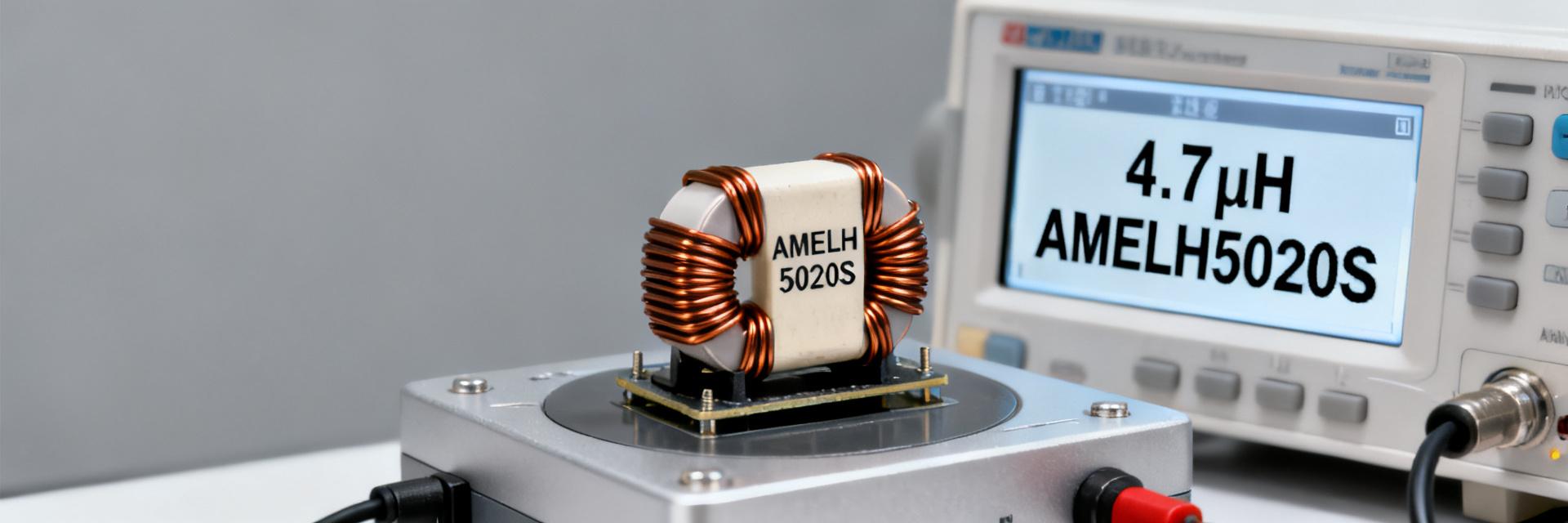
Typical applications and topologies
Point: A 4.7µH inductor often fits mid-frequency switching topologies. Evidence: designers commonly choose this value for synchronous buck converters, point-of-load supplies, and mid-frequency filters. Explanation: Compared with lower inductances, 4.7µH reduces ripple current and eases filtering at moderate switching frequencies; versus higher inductances it offers faster transient response. When to use 4.7µH inductor in buck converter comes down to ripple, transient budget, and board area trade-offs.
Key electrical parameters
Point: Inductance alone does not guarantee performance. Evidence: critical parameters include inductance tolerance, DCR, rated (Irms) and saturation (Isat) currents, SRF, and thermal limits reported on the manufacturer datasheet. Explanation: DCR drives I²R loss and heating; Isat defines the converter peak current margin; SRF constrains high-frequency behavior and EMI. For switching frequencies from 300 kHz–2 MHz, target parts with low DCR (tens of milliohms) and Isat comfortably above peak currents.
2 — AMELH5020S-4R7MT: datasheet-driven spec checklist
| Parameter Category | Critical Verification Point | Rule-of-Thumb / Threshold |
|---|---|---|
| Electrical Specs | Isat (Saturation Current) | Select Isat > 1.2× peak converter current |
| Efficiency | DCR (mΩ) | Target tens of mΩ; consistent with efficiency goals |
| Stability | SRF (Self-Resonant Freq) | SRF must be above switching harmonics |
| Reliability | Thermal Derating | Check allowable Irms at target board temperature |
Mechanical & reliability checks
Point: Mechanical suitability affects assembly and longevity. Evidence: review package dimensions, height, pad footprint, termination style, and shock/vibration ratings from the datasheet. Explanation: Confirm PCB footprint and reflow compatibility (stencil aperture and wetting). Ensure height and clearance meet thermal and mechanical constraints and derate current with ambient or PCB temperature—thermal derating curves or tables on the datasheet guide allowable Irms at target board temperatures.
3 — How to choose the right 4.7µH power inductor for your board
Electrical selection flow:
Point: Follow a decision flow from system specs to part selection. Evidence: start with switching frequency and target ΔI, compute required inductance and ripple, then set Isat and thermal margins.
Explanation: Use the formula above to calculate ripple current for 4.7µH inductor examples; if ΔI is too large, pick lower L or increase switching frequency. Set Isat ≥ 1.2–1.5× peak switch current and choose DCR to meet efficiency goals.
Layout & system-level considerations
Point: PCB layout often determines real-world EMI and thermal performance. Evidence: minimize converter loop area, place decoupling close to the switch node, and route high-current traces with adequate width and thermal vias. Explanation: Orient the inductor to reduce coupling into sensitive traces, keep it away from ADC or RF blocks, and consider simple shielding or ferrite beads if EMI signatures persist. For BOM resilience, identify 2–3 alternates with similar electrical/mechanical specs for cross-qualification.
4 — How to test AMELH5020S-4R7MT: bench procedures and in-circuit verification
Bench measurements (LCR, DCR, SRF, Isat)
Point: Component-level tests validate datasheet claims. Evidence: perform LCR meter measurements at relevant frequencies, four-wire DCR checks, swept impedance or VNA to locate SRF, and DC-bias tests to estimate Isat. Explanation: Use an LCR meter at the converter operating frequency or an equivalent test frequency; measure DCR with a milliohm meter using Kelvin leads; sweep impedance to find SRF above switching harmonics. Acceptance: L within tolerance under bias, DCR within a few percent of datasheet, and Isat margin > 20% are practical criteria.
In-circuit & dynamic tests
Point: Live tests reveal saturation and thermal issues not seen on the bench. Evidence: measure ripple with a properly grounded scope probe and a current probe, place a thermocouple on the inductor, and perform load-step tests. Explanation: For ripple, probe the output directly across a low-inductance loop; sudden load steps expose saturation (rapid increase in ripple) and slow thermal rise indicates excessive I²R loss. EMI scans and spectrum signatures pointing to switching harmonics or broadband noise often correlate with inductor selection or layout issues.
5 — Practical checklist and troubleshooting
Pre-production checklist
Evidence: include BOM cross-checks, footprint verification, stencil aperture, thermal derating, and approved alternates. Explanation: For prototypes, inspect fillets, perform initial low-power smoke tests, and capture test logs and thermal images. Record measured L vs. current curves for the part lot to aid root-cause analysis.
Common failure modes & fix
Evidence: symptoms include overheating, high ripple/EMI, unexpected loss, or mechanical cracking. Explanation: Mitigations: increase Isat margin or lower RMS current, improve cooling, change placement, or add snubbers. A simple flow—measure DCR and L, check temperature, then inspect layout—speeds field triage.
Summary
- Verify the AMELH5020S-4R7MT datasheet values—4.7µH inductance, DCR, Isat, SRF—and confirm they meet ripple and efficiency targets before PCB sign-off.
- Follow the electrical selection flow: compute ΔI with ΔI = Vout*(1–D)/(L*f), set Isat ≥1.2× peak current, and choose DCR to meet thermal/efficiency goals.
- Use both bench and in‑circuit tests—LCR, four‑wire DCR, SRF sweep, load‑step ripple, thermal profiling—to catch saturation and loss early.
- Apply practical layout rules and a pre-production checklist to avoid assembly and EMI issues; keep alternate parts qualified for supply resilience.
Frequently Asked Questions
How to test AMELH5020S-4R7MT inductance and DCR?
Use an LCR meter at the converter-relevant frequency to measure inductance and a four-wire milliohm method for DCR. Verify L under DC bias comparable to operating current; if L drops significantly near expected peak currents, the part may approach saturation.
What is an acceptable Isat margin for AMELH5020S-4R7MT in a buck converter?
A practical guideline is Isat ≥ 1.2–1.5× peak converter current; this margin reduces saturation risk during transients. Confirm with load‑step tests—if ripple jumps markedly under step loads, raise the Isat margin or reduce RMS current.
How to calculate ripple current for 4.7µH inductor?
Use ΔI = Vout*(1–D)/(L*f) for a buck topology. Plug L = 4.7µH and your switching frequency and duty cycle to confirm resulting ΔI is within capacitor ripple handling and thermal limits; adjust L or f if the result is excessive.