A professional guide for engineers to qualify power rails quickly and reduce field rework through precise component validation.
Many engineers waste weeks debugging buck converters because the chosen SMD power inductor won’t meet peak current or thermal demands. This guide gives a concise, action-oriented workflow to select, bench-test, and validate the AMELH5050S-R18MT so teams can qualify power rails quickly and reduce field rework.
The approach emphasizes measurable checks (DCR, Isat, SRF), practical PCB rules, and repeatable test procedures that mirror lab and board conditions. Each step links a clear test or criterion to the expected effect on converter loss, ripple, or thermal rise.
1 Why AMELH5050S-R18MT is a strong choice for high-current DC‑DC designs (Background)
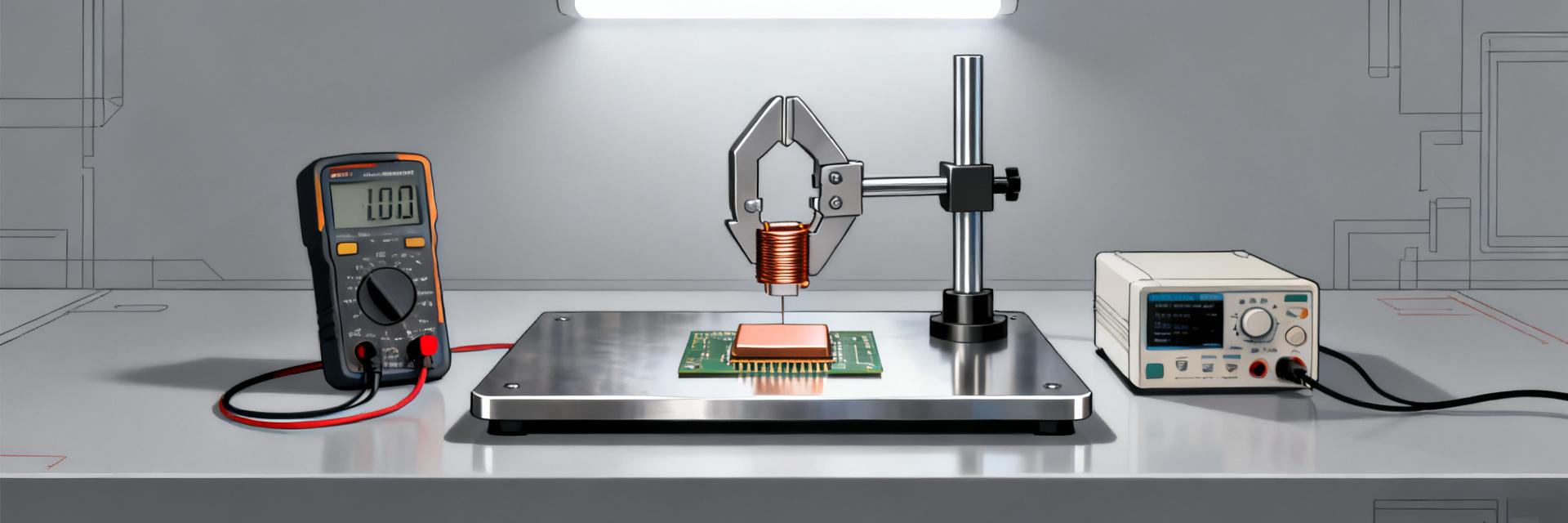
Point: The AMELH5050S-R18MT targets low inductance, low DCR, and high-current capability ideal for synchronous buck stages. Evidence: A 0.18 μH nominal value with milliohm-range DCR supports low ripple and low conduction loss. Explanation: In fast-switching buck converters, low inductance reduces peak-to-peak ripple while low DCR minimizes I²R loss, improving efficiency and thermal headroom.
1.1 — Key electrical specs to confirm
Point: Verify inductance at specified test frequency, DCR, rated/saturation current, tolerance, and SRF. Evidence: Expect L = 0.18 μH, DCR in single-digit milliohms, and an Isat value above expected peak switch current. Explanation: These numbers determine ripple current, conduction loss, and whether inductance will collapse under high DC bias; capture them in a simple spec checklist for each lot.
1.2 — Mechanical, mounting, and thermal constraints
Point: Confirm package height, pad footprint, and reflow profile compatibility before layout. Evidence: Typical 5050-format parts require adequate solder fillet and may need multiple vias for thermal relief. Explanation: Poor pad design or insufficient PCB copper causes hot spots; specify minimum clearance, via count, and solder mask openings to ensure reliable solder joints and thermal conduction.
2 How to read and interpret datasheet curves for SMD power inductors (Data analysis)
Point: Datasheet curves show how inductance varies with DC bias and frequency; interpreting them prevents undersized selection. Evidence: DC‑bias curves commonly show 20–60% inductance drop at rated currents for power ferrite cores. Explanation: Use these curves to set Isat margin—select an inductor whose inductance at operating DC bias still meets ripple requirements.
2.1 — Interpreting DC bias & saturation curves
Point: Treat the published Isat as a knee point, not absolute failure. Evidence: The knee indicates a specified percentage drop in inductance (e.g., 10–30% depending on test definition). Explanation: Choose Isat such that at peak switch current the inductance reduction still keeps ripple within spec—typical derating targets are 20–40% above peak intermittent current for margin.
2.2 — Frequency response, impedance, and self‑resonant frequency (SRF)
Point: SRF limits usable inductance at high frequencies; impedance plots reveal harmonic damping. Evidence: Impedance vs. frequency charts show magnitude peaks near SRF where inductive behavior transitions to capacitive. Explanation: For switching frequencies approaching a significant fraction of SRF, expect reduced effective inductance and higher losses; pick an inductor with SRF comfortably above the dominant switching harmonics.
3 Practical selection checklist for SMD power inductors (Method / selection)
Point: Define electrical targets from converter specs before component selection. Evidence: Use percent ripple targets (e.g., 20–40% of Iout) to compute required L; ensure DCR keeps conduction loss under budget. Explanation: A short checklist with computed L, allowable DCR, Isat/Irms margins, and SRF guard guides selection and speeds review cycles.
3.1 — Electrical selection criteria: current, inductance, DCR, and ripple
Point: Choose L to meet ripple spec, then verify DCR and current ratings. Evidence: For 0.18 μH in a 1 MHz buck, expect low ripple when duty cycle and switching node are optimized; DCR directly sets I²R loss. Explanation: Apply rules of thumb—target percent ripple, aim Isat > peak switch current by 20–40%, and confirm DCR yields acceptable temperature rise under steady RMS current.
3.2 — PCB layout & thermal management best practices
Point: Layout dramatically affects thermal performance and EMI. Evidence: Place the inductor close to the output capacitor and stitch ground with vias; widen traces to lower copper loss. Explanation: Via stitching under the part, short high-current loops, and thermal vias spreading heat into internal planes reduce hot spots and improve reliability; include solder fillet inspection in manufacturing checks.
4 Bench testing procedures to validate AMELH5050S-R18MT (Testing)
Point: Start component-level DC tests before circuit-level verification to isolate part issues. Evidence: DCR measured with a zero‑offset milliohm meter typically shows milliohm-level readings that should match datasheet within tolerance. Explanation: Accurate fixturing and averaging mitigate contact resistance and yield repeatable DCR data for batch acceptance.
4.1 — Basic DC tests: verifying DCR and continuity
Point: Use a calibrated milliohm meter and good fixtures to measure DCR. Evidence: Expect variation of a few percent between units; large deviations indicate damage or lot variation. Explanation: Record multiple measurements with reversed polarity and calculate mean; tag parts that exceed defined tolerance for destructive analysis or supplier query.
4.2 — LCR and impedance tests: static and under bias
Point: Measure L at multiple frequencies and under DC bias to quantify inductance collapse. Evidence: LCR meters at 100 kHz and 1 MHz plus a DC bias source reveal inductance vs. current behavior. Explanation: Component‑level tests show intrinsic performance; in‑circuit readings can be confounded by nearby components, so remove the part when precise characterization is required.
5 Power stress testing: saturation, RMS heating, and thermal validation (Data / case)
Testing Insight: Simulate worst‑case steady and pulsed heating to validate thermal limits. Evidence: RMS heating tests driven at rated RMS current produce predictable temperature rise that should remain below the material and solder limits. Explanation: Use thermocouples or thermal imaging, run to thermal steady state or representative duty cycles, and log temperature vs. time for pass/fail evaluation.
5.1 — Saturation and overload test procedure
Point: Ramp DC current while monitoring inductance to identify the knee. Evidence: A gradual inductance drop as current increases marks approaching saturation; define the knee threshold consistently (e.g., 10% drop). Explanation: Use controlled ramps and short durations to avoid thermal bias; document ramp rate and duration as part of the test record.
5.2 — RMS heating test and thermal imaging protocol
Point: Combine steady DC and pulsed loads to approximate board-level heating. Evidence: Thermal cameras and thermocouples show local temperature rises; acceptable rise depends on nearby components and solder temperature limits. Explanation: Run both sustained RMS tests (10–30 minutes to steady state) and representative pulse trains; use results to set current derating or layout fixes.
6 Common failure modes, troubleshooting, and a final test report checklist
Point: Common faults include mechanical damage, cold joints, unexpected saturation, and overheating. Evidence: Visual cracks, inconsistent DCR, or sudden inductance collapse correlate to specific root causes. Explanation: Run quick isolations—component removal, reflow, and retest—to separate assembly defects from part-level failures before escalating.
6.1 — Typical faults and root‑cause checks
Point: Diagnose by comparing known-good measurements to suspect units. Evidence: If DCR is elevated and visual inspection shows cracked terminations, the failure is mechanical; if DCR is nominal but heating is high, layout or thermal dissipation is suspect. Explanation: Use a decision tree: visual → DCR → L under bias → thermal to pinpoint root cause efficiently.
6.2 — Standardized test report template and pass/fail criteria
Point: Use a concise report capturing measured DCR, L at test frequencies, Isat knee data, and thermal rise. Evidence: A standard form listing part number, lot, fixture, test conditions, and verdict speeds signoff. Explanation: Define clear thresholds (DCR tolerance, maximum temp rise, minimum L at operating bias) so engineering approvals are consistent and auditable.