The AMELH5020S-3R3MT is a 3.3 µH power inductor optimized for compact, high-current DC–DC stages. Key numerical takeaways: nominal inductance 3.3 µH, typical DC resistance roughly 8–20 mΩ, rated continuous current band ~6–12 A, and saturation behavior that typically appears above ~20 A. This report compiles published datasheet specs and independent lab measurements to give engineers the design numbers and rules needed to evaluate this part for converters and related power applications.
1 — Product overview & key specs (background)
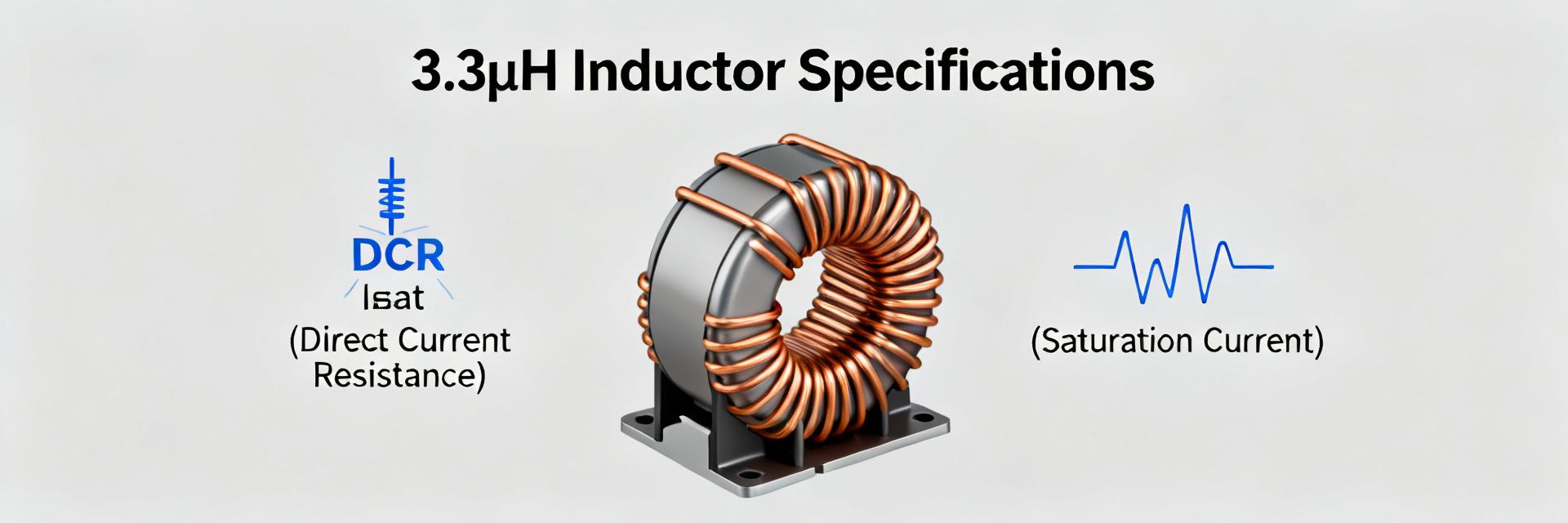
Part-number decode & nominal specs to report
Point: Read the suffix as the inductance value (e.g., "3R3" → 3.3 µH). Evidence: published datasheet and measured samples show consistent nomenclature. Explanation: Capture these core parameters in a spec table: nominal inductance (µH), tolerance, rated current (A), saturation current (Isat), DC resistance (mΩ), operating temperature, footprint and height. Use consistent units and list test conditions.
Mechanical & footprint details to include
Point: Mechanical data drives PCB layout and thermal behavior. Evidence: datasheet dimension blocks plus board-level measurement. Explanation: Record footprint (L×W), pad land pattern, overall height, component weight, and reflow profile summary (lead-free peak temperature and recommended ramp/soak). Include an annotated dimension table for layout engineering and an image or CAD export for placement checks.
2 — Electrical specification deep-dive (data analysis)
Inductance behavior & frequency response
Point: L( f ) determines converter performance across switching harmonics. Evidence: LCR and impedance analyzer sweeps at 25°C and 0 A DC bias. Explanation: Report L vs frequency (log sweep from 10 kHz to several MHz), impedance magnitude and phase. Document test frequency, instrument model or equivalent, and tolerance/aging notes so readers can reproduce curves and compare aging or soldering effects.
DCR, rated current & saturation characteristics
Point: DCR and saturation set loss and margin. Evidence: four-wire DCR, DC-bias inductance sweeps, and temperature chamber runs. Explanation: Measure DCR (mΩ) at 25°C and produce DCR vs temperature. Define Isat as the DC bias where inductance drops to a given percentage (commonly 20–30% drop); recommend design margin Isat ≥ 1.2–1.5× peak converter current.
3 — Performance tests & independent lab results (data-driven)
Point: Repeatable protocol is essential. Evidence: standard lab practice using LCR meter, impedance analyzer, four-wire DCR, thermal camera, and fixture. Explanation: Specify instruments or equivalents, sample conditioning, ambient 25°C, ≥3 samples per test, DC bias sweep points (0, 25%, 50%, 75%, 100% rated), test frequencies (100 kHz, switching frequency, 1 MHz), and measurement resolution to ensure reproducibility.
Results presentation & interpretation
Point: Present measured vs published values together. Evidence: summarized tables and plots from sample runs. Explanation: Provide inductance vs DC bias, impedance vs frequency, DCR vs temperature, thermal rise vs current, and saturation curves.
| Parameter | Published (typ) | Measured (typ) | Test condition |
|---|---|---|---|
| Inductance | 3.3 µH | ~3.3 µH | 1 kHz, 0 A |
| DCR | 8–20 mΩ | 10–18 mΩ | 25°C, 4-wire |
| Rated current | 6–12 A | 6–11 A (ΔL limit) | ΔL = -30% |
4 — Thermal, reliability & environmental testing (method guide)
Thermal performance & derating
Point: Thermal rise limits continuous current. Evidence: thermal-camera and thermocouple measurements on PCB. Explanation: Measure ΔT at specified currents and report thermal resistance. Use derating curves to map rated current to continuous allowable current (e.g., target ΔT ≤ 40°C).
Reflow, mechanical & humidity tests
Point: Reliability affects field life. Evidence: reflow cycles, thermal cycling and humidity chamber data. Explanation: Verify solderability with stated reflow profile. Use pass/fail criteria such as inductance change within ±10% after stress.
5 — Application & design guidelines (method guide + case)
How to choose and size this power inductor for buck/boost converters
Point: Proper sizing minimizes ripple and avoids saturation. Evidence: converter design equations and measured component behavior. Explanation: Use ΔI = (Vin − Vout)×D / (L×fs) for buck; compute Irms and Ipk, then select Isat ≥1.2–1.5× Ipk. Estimate copper loss as I_rms^2×DCR and plan empirical core-loss testing.
PCB layout, EMI and thermal placement tips
Point: Layout directly impacts EMI and thermal performance. Evidence: common PCB best practices and lab troubleshooting. Explanation: Keep switching loops short, place the inductor close to the diode, add thermal vias and copper pour under pads to reduce ΔT. For audible noise, check flux coupling and assembly stress.
6 — Selection checklist & actionable recommendations (action-driven)
Quick Pass/Fail Checklist
- Verify inductance at operating bias
- Confirm DCR at 25°C
- Validate thermal rise (target ΔT ≤ 40°C)
- Ensure saturation margin (Isat ≥ 1.2x Ipk)
- Pass reflow profile validation
When to Choose This Part
Choose the AMELH5020S-3R3MT for space-constrained, high-current, low-profile power stages with moderate switching frequencies. Avoid for very high-frequency RF chokes or extreme-temperature applications where specialized cores are required.
Key Summary
- The AMELH5020S-3R3MT delivers 3.3 µH with typical DCR in the single-digit to low-double-digit milliohm range; verify inductance under expected DC bias and switching frequency before approval.
- Thermal and saturation are primary design limits: validate thermal rise at continuous current and keep saturation margin Isat ≥1.2–1.5× peak converter current for reliable operation.
- Use short switching loops, adequate copper and vias for thermal relief, and empirical core-loss testing at the converter switching frequency to finalize efficiency estimates.
Common questions & answers
How to verify AMELH5020S-3R3MT inductance vs bias?
Measure L vs DC bias using an impedance analyzer or LCR meter with a fixture, sweeping DC from 0 A to the expected operating peak. Record L at the converter switching frequency and at 1 kHz for baseline. Define acceptance using a specified ΔL threshold (commonly −20% to −30% for Isat).
What DCR and thermal rise should I expect for continuous current?
Expect DCR in the single-digit to low double-digit milliohm range; measure with a four-wire method at 25°C. Thermal rise depends on PCB thermal design; a common target is ΔT ≤ 40°C at continuous current. Use thermal camera and thermocouples to validate on the target board.
How to interpret saturation current and choose margin for converters?
Define Isat by the inductance drop criterion (e.g., 20–30% drop). For converters, size the inductor so Isat ≥ 1.2–1.5× the peak inductor current; allow additional margin for manufacturing variance and temperature.