A professional engineering roadmap for selecting and validating high-current power inductors in switching rail designs.
Selecting and validating an SMD power inductor that reliably carries a 23A switching rail without excessive loss, saturation, or overheating is a common pain for power supply designers and hardware engineers. This guide gives a clear, step-by-step sizing method for the AMELH5030S-R60MT, producing a safe inductance value, thermal estimate, and a small validation checklist for prototype testing.
1 AMELH5030S-R60MT: key specs to read and why they matter [Background]
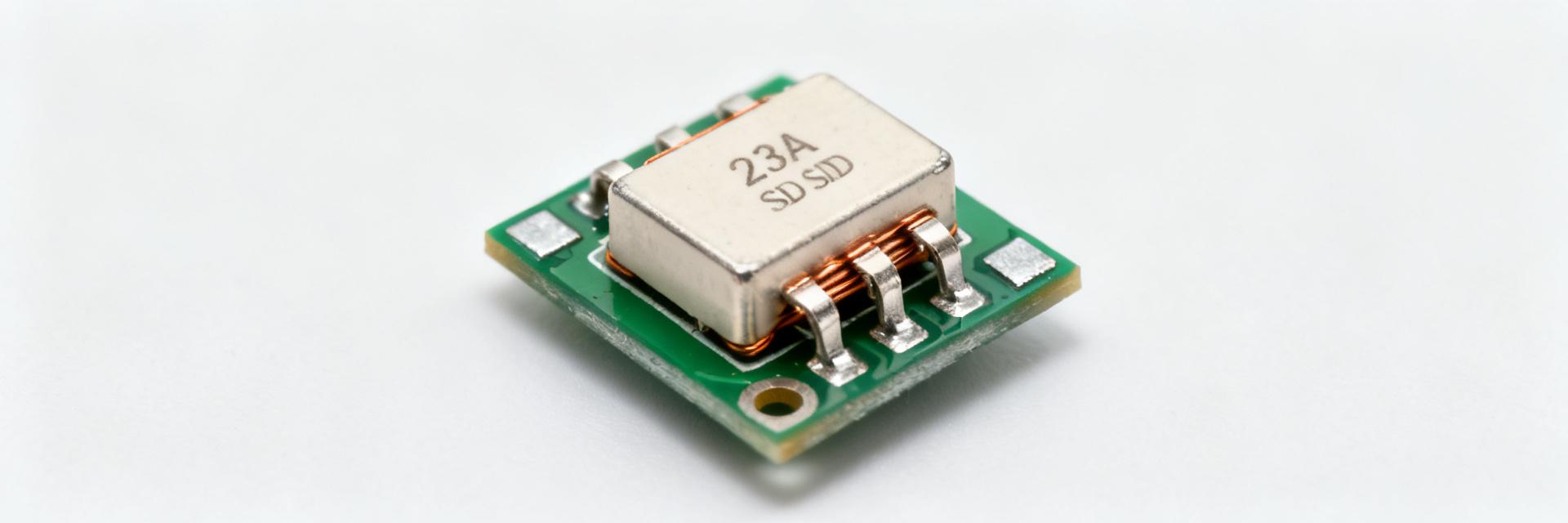
What datasheet numbers determine 23A suitability
Point: The essential datasheet fields to extract are nominal inductance, DC resistance (DCR), saturation current (Isat), rated/Irms current, package footprint and height, core material, and thermal limits. Evidence: The manufacturer datasheet typically lists these values in a single table. Explanation: These numbers directly control ripple, Ipeak vs. Isat margin, conduction loss, mechanical fit and safe operating temperature; confirm each before acceptance.
Interpreting Isat vs. Irms vs. thermal limits
Point: Isat indicates the DC bias at which inductance falls by a specified amount, while Irms is a heating limit often tied to a temperature rise. Evidence: Datasheet Isat curves and Irms ratings reflect core material and winding. Explanation: Use safety margins: target Isat ≥ Ipeak × 1.3 (1.2–1.5 depending on criticality) and Irms ≥ Iavg × 1.1; verify temperature rise with copper area and vias to avoid thermal derating.
(2) Electrical sizing formulas & ripple targets for 23A rails [Data analysis]
How to calculate inductance given switching specs
Formula Focus: Calculate L from switching parameters using L = (Vin × D) / (ΔI × Fs) for a buck converter.
Point: This relationship follows volt-second balance on the inductor during ON time. Explanation: Define variables: ΔI target (20–40% of Iout), D = Vout/Vin, Fs in Hz. Keep units consistent: V, A, Hz, H. Use a ΔI that balances efficiency and transient response.
Selecting ripple current and peak current margins
Point: Choose ΔI_ripple, then compute Ipeak = Iout + ΔI/2 and I_RMS for loss estimates. Evidence: For a 23A SMD power inductor a typical ΔI = 20% → 4.6 A. Explanation: With Ipeak and chosen margin, validate Isat ≥ Ipeak×1.3; this ensures inductance does not collapse at worst-case input and transient peaks. Adjust ΔI for EMI and efficiency trade-offs.
(3) Thermal, DCR loss and PCB heat management [Method / practical]
Estimating power loss and temperature rise
Point: Compute copper loss as P_loss = I_RMS^2 × DCR; compute I_RMS ≈ sqrt(Iout^2 + (ΔI^2)/12) for triangular ripple. Evidence: This provides a first-order estimate of winding heating. Explanation: Use results to predict temperature rise; if P_loss is high, iterate on ΔI, DCR target, or thermal vias.
PCB layout and mechanical/thermal best practices
Point: Minimize thermal resistance via large copper pours and multiple thermal vias. Evidence: IPC land patterns reduce localized heating. Explanation: Place the inductor to honor airflow, use generous pad lands, and confirm solder fillet quality.
(4) Managing saturation, core loss and EMI at high current [Data & method]
Core saturation behavior under DC bias
DC bias reduces effective inductance; the L vs. I curve shows this behavior. If inductance drops too far, ripple increases and stability is affected. Choose parts with higher Isat or larger initial L.
EMI and filter role
Keep input caps close to the switch, output caps close to the load, and orient inductors to minimize loop area. Characterize impedance vs. frequency with an analyzer to confirm EMI behavior.
(5) Selection checklist & derating rules [Actionable guide]
- ✔ Isat Check: Isat ≥ Ipeak × 1.3
- ✔ Irms Check: Irms ≥ 23 A
- ✔ DCR Target: Low enough so P_loss fits thermal budget (e.g., < 10 mΩ).
(6) Case study — sizing the AMELH5030S-R60MT [Worked example]
Given: Vin=12V, Vout=1.2V, Fs=500kHz, Iout=23A, ΔI target=20% (4.6A).
Verification: Compare these values to AMELH5030S-R60MT datasheet Isat and Irms to judge suitability. If limits are exceeded, consider paralleling inductors or lowering switching frequency.
FAQ
How do I confirm AMELH5030S-R60MT will not saturate at 23A?
Measure Ipeak from your ΔI and Iout, then compare to the datasheet Isat curve; require a safety margin (commonly ×1.2–1.5).
What practical steps reduce inductor temperature on a dense PCB?
Increase copper pour, add multiple thermal vias beneath the pad, keep switching loop short, and orient the part for airflow.
When should I consider paralleling inductors for 23A?
Parallel only if single-part Isat or thermal ratings are inadequate and the topology tolerates increased footprint.