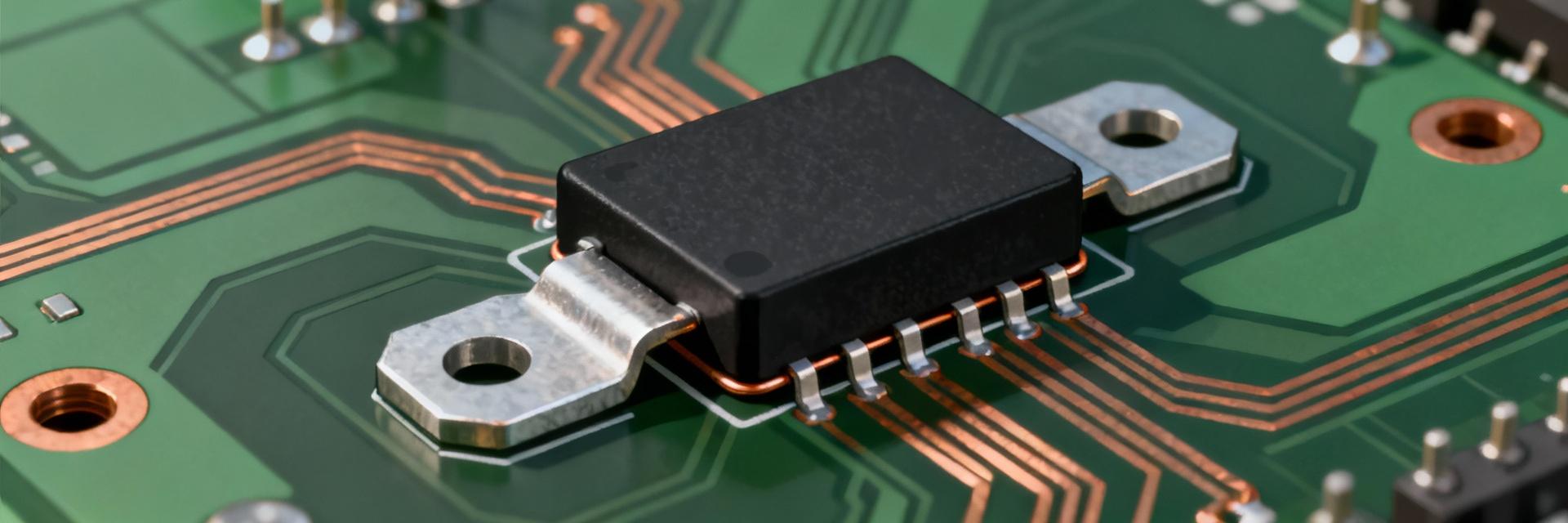
Core Insight: High-current SMD power inductors are a primary limiter of efficiency, thermal margin and transient performance in modern buck regulators. Evidence: Design heuristics show many buck rails use inductor ripple of 10–40% of load current and designers commonly target inductance in the 2.2 µH–10 µH range with current rating ≥1.25–1.5× steady DC load. Application: This guide explains how these device-level choices translate to ripple, losses and thermal behavior, and gives practical, testable selection and layout steps for power-design engineers.
Background — Role of High-Current SMD Inductors in Buck Converters
Inductor function and key electrical relationships
Point: The inductor stores energy and smooths current, directly setting inductor ripple and interacting with output capacitance to determine output voltage ripple.
Evidence: For an ideal buck, peak-to-peak inductor ripple current is ΔI_L = (V_in − V_out)·D / (L·f_s), with D = V_out/V_in.
Explanation: That ΔI shapes capacitor RMS current, affects ESR loss and the converter’s transient headroom; lower ΔI reduces capacitor stress but can slow transient response.
Numeric Example: For Vin=12 V, Vout=1.2 V, f_s=500 kHz and L=1.5 µH, D=0.1 so ΔI = (12−1.2)·0.1 / (1.5e‑6·500e3) = 1.44 A p‑p.
This ripple on a low-voltage rail shows how modest inductances produce appreciable ripple currents that drive output capacitor RMS current and heating; designers must compare that to capacitor ratings and allowed ripple % of load.
SMD inductor families and magnetic behavior
Point: Core material and packaging determine DC‑bias behavior, saturation and thermal rise—critical at high DC currents.
Evidence: Ferrite cores typically have pronounced L vs I droop and a sharp saturation knee, while powdered cores show gentler derating but higher core loss at switching frequency.
Explanation: For high-current designs choose parts with documented L vs DC‑bias curves, an Isat value above expected peak current, and thermal limits compatible with board cooling.
Point: Rated current vs saturation current are different datasheet metrics that must be reconciled during selection.
Evidence: Rated current often refers to allowable temperature rise or L change, while Isat refers to a specific L drop (e.g., 10–30% loss).
Explanation: Specify both I_rated margin (1.25–1.5× steady) and Isat margin to avoid large inductance loss or abrupt saturation under worst-case operating points and ambient conditions.
Data-driven Performance Factors & Trade-offs
Quantifiable metrics to track
Track ΔI, I_RMS, DCR and core loss to quantify inductor-related efficiency loss and thermal rise. Copper loss ≈ I_RMS^2 × DCR; I_RMS for triangular ripple ≈ sqrt(I_DC^2 + ΔI^2/12).
| Metric | Typical Range | Estimated Impact (Visual Analysis) |
|---|---|---|
| DCR | 1–10 mΩ |
|
| ΔI (p‑p) | 0.5–5 A |
|
| Core loss | Low→Moderate |
|
Design trade-offs: inductance value vs performance
-
●
Point: Increasing L reduces ripple but slows transient response and can raise core losses at higher f_s.
Evidence: Rule of thumb: many high-current rails use 2.2–10 µH; margin 1.25–1.5×. -
●
Point: Frequency increase allows smaller L but raises core loss and EMI sensitivity.
Evidence: Doubling f_s halves required L for same ΔI but core loss often increases nonlinearly.
Modeling & Selection Method
Step-by-Step Selection
Workflow: Define specs → Calculate L → Compute I_RMS/I_peak → Apply margin → Compare curves.
Example: For 12→1.2 V at 20 A, f_s=500 kHz, L=2.2 µH gives ΔI ≈ 0.98 A p‑p (~4.9% of load). This keeps capacitor stress low and DCR losses acceptable (~0.8 W).
SPICE & Prototype Verification
Accuracy: Incorporate L(I), series resistance and frequency‑dependent core loss in models.
Validation: Use scope captures of inductor current and switch node, efficiency sweeps, and thermal imaging. Fail if temp rise >40–50 °C above ambient.
PCB Layout, Thermal Management and EMI Best Practices
Layout Actions
Minimize high di/dt loop area, place the inductor close to output caps, keep input traces short and use wide copper pours and thermal vias under the part to reduce radiated EMI and spread heat.
Reliability & Mitigation
Derate for ambient conditions. Target temp rise ≤40 °C. Verify mechanical reliability and add filtering if EMI limits are approached. Confirm component solderability to your IR profile.